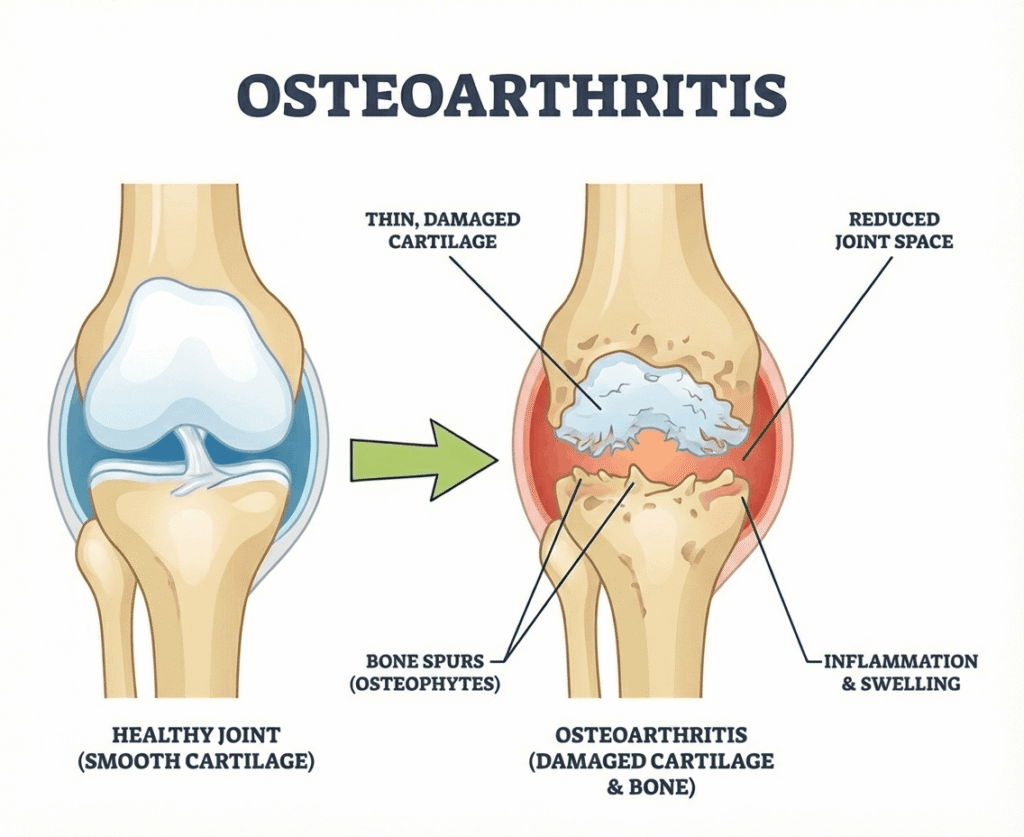

Question 1
A 55-year-old woman with a BMI of 32 kg/m² is diagnosed with osteoarthritis. She asks if her weight has anything to do with her condition. What would be the most appropriate response?
A) Obesity is not related to the development of osteoarthritis
B) Obesity is a known risk factor for osteoarthritis, especially in weight-bearing joints
C) Osteoarthritis is only influenced by age, not by weight
D) Weight has no impact on osteoarthritis, but it may affect other conditions
E) Obesity only affects the upper body joints, not the lower body joints
Click to see the answer
Correct Answer: B) Obesity is a known risk factor for osteoarthritis, especially in weight-bearing joints
Explanation: Obesity is a significant risk factor for osteoarthritis, particularly in the knees, hips, and other weight-bearing joints, due to the increased mechanical stress on these areas.
Question 2
A 70-year-old patient with a history of diabetes and cirrhosis is prescribed NSAIDs for osteoarthritis pain. What is the primary concern regarding the use of NSAIDs or COX-II inhibitors in this patient?
A) Increased risk of cardiovascular events
B) Risk of renal toxicity due to volume depletion, diabetes, age, and cirrhosis
C) Decreased effectiveness of the NSAIDs due to age
D) Increased risk of gastrointestinal bleeding without any additional concerns
E) Reduced joint pain relief due to the patient’s comorbidities
Click to see the answer
Correct Answer: B) Risk of renal toxicity due to volume depletion, diabetes, age, and cirrhosis
Explanation: NSAIDs and COX-II inhibitors can increase the risk of renal toxicity in patients with predisposing factors such as volume depletion, diabetes, advanced age, and liver disease like cirrhosis.
Question 3
A patient with osteoarthritis is recommended acetaminophen for pain relief. The recommended dose is 650 mg every 4-6 hours. What is the maximum number of tablets they should take per day?
A) 4 tablets
B) 6 tablets
C) 8 tablets
D) 10 tablets
E) 12 tablets
Click to see the answer
Correct Answer: B) 6 tablets
Explanation: The recommended dose of acetaminophen for osteoarthritis pain is 650 mg every 4-6 hours, with a maximum of 6 tablets daily to avoid exceeding the safe dosage and risking liver toxicity.
Question 4
A patient taking acetaminophen for osteoarthritis pain reports developing a rash. What is the most appropriate action?
A) Stop acetaminophen immediately and seek medical advice
B) Continue taking acetaminophen and apply a topical steroid for the rash
C) Reduce the dosage of acetaminophen but continue using it
D) Switch to a different pain medication without seeking medical advice
E) Ignore the rash as it is unrelated to acetaminophen use
Click to see the answer
Correct Answer: A) Stop acetaminophen immediately and seek medical advice
Explanation: Rash can be a possible side effect of acetaminophen, and discontinuation is recommended to avoid further complications, such as a potential allergic reaction.
Question 5
A 45-year-old man accidentally took 10 grams of acetaminophen in one day while managing his osteoarthritis pain. What is the primary concern regarding acetaminophen overdose?
A) Renal failure
B) Cardiotoxicity
C) Hepatotoxicity
D) Bone marrow suppression
E) Gastrointestinal ulcers
Click to see the answer
Correct Answer: C) Hepatotoxicity
Explanation: Acetaminophen overdose can lead to hepatotoxicity, which may result in severe liver damage or failure if not promptly treated.
Question 6
A patient is using capsaicin cream to relieve joint pain from osteoarthritis. What precautions should the patient be advised to follow?
A) Apply on open wounds for quicker relief
B) Wash hands thoroughly after use and avoid applying to open wounds, cuts, or eyes
C) Apply to large areas of skin to maximize effectiveness
D) Use alongside heating pads for better absorption
E) Use only once a week to prevent irritation
Click to see the answer
Correct Answer: B) Wash hands thoroughly after use and avoid applying to open wounds, cuts, or eyes
Explanation: Capsaicin should not be applied to open wounds, cuts, or near the eyes, and hands should be washed after use to prevent irritation.
Question 7
A patient with osteoarthritis asks about appropriate exercises to help manage the condition. What would be the best recommendation?
A) Weight-bearing exercises such as walking, running, jogging, jumping, and light lifting
B) High-intensity interval training (HIIT)
C) Only avoid exercise to prevent further joint damage
D) Focus solely on upper body exercises
E) Swimming and water-based exercises only
Click to see the answer
Correct Answer: A) Weight-bearing exercises such as walking, running, jogging, jumping, and light lifting
Explanation: Weight-bearing exercises, such as walking and light lifting, are recommended for osteoarthritis as they help strengthen muscles around the joints and improve mobility.
Question 8:
A 50-year-old male comes to the pharmacy seeking advice on how to relieve his knee pain caused by osteoarthritis. He asks if using a capsaicin topical cream might be beneficial. What is the source of capsaicin?
A) Chili peppers
B) Mustard plants
C) Clove oil
D) Ginger root
E) Menthol leaves
Click to see the answer
Answer:
A) Chili peppers
Explanation:
Capsaicin is a compound obtained from capsicum, commonly found in chili peppers, and is often used topically for pain relief, particularly for conditions like osteoarthritis.
Question 9:
A patient with osteoarthritis has not experienced sufficient pain relief from regular acetaminophen. The pharmacist recommends switching to a combination product. What is the recommended product for patients who need additional pain relief?
A) Acetaminophen 300 mg + codeine 8 mg + caffeine 15 mg
B) Naproxen 500 mg + acetaminophen 325 mg
C) Ibuprofen 400 mg + aspirin 81 mg
D) Celecoxib 200 mg + acetaminophen 650 mg
E) Morphine sulfate 10 mg
Click to see the answer
Answer:
A) Acetaminophen 300 mg + codeine 8 mg + caffeine 15 mg
Explanation:
If acetaminophen alone is not providing sufficient relief for osteoarthritis, the next step could be to try a combination product like acetaminophen 300 mg + codeine 8 mg + caffeine 15 mg for better pain control.
Question 10
A patient is considering using glucosamine and chondroitin for osteoarthritis. What should the patient understand about these supplements?
A) They directly relieve pain like NSAIDs
B) They help support cartilage health and maintain joint function
C) They work immediately to reduce joint swelling
D) They cause significant side effects, so regular monitoring is required
E) They should be used only as a last resort
Click to see the answer
Correct Answer: B) They help support cartilage health and maintain joint function
Explanation: Glucosamine and chondroitin are supplements believed to support cartilage health and help maintain joint function in patients with osteoarthritis.
Question 11
A 60-year-old patient with osteoarthritis is receiving intraarticular methylprednisolone injections for pain relief. What is the maximum number of injections recommended per year for each joint?
A) 1 injection
B) 2 injections
C) 3 injections
D) 5 injections
E) No limit on the number of injections
Click to see the answer
Correct Answer: C) 3 injections
Explanation: Methylprednisolone injections are used for intraarticular treatment of osteoarthritis, with a recommended limit of 3 injections per year per joint to prevent potential joint damage.
Question 12
A patient with osteoarthritis is considering hyaluronic acid injections instead of corticosteroids. What should the patient know about hyaluronic acid injections?
A) They provide immediate pain relief
B) They offer longer-lasting relief than corticosteroids
C) They are less effective than corticosteroids for pain management
D) They are only used for minor joint pain
E) They increase the risk of infection compared to corticosteroids
Click to see the answer
Correct Answer: B) They offer longer-lasting relief than corticosteroids
Explanation: Hyaluronic acid injections may provide longer-lasting relief compared to corticosteroids, particularly in managing osteoarthritis symptoms.
Question 13
A 65-year-old patient with osteoarthritis is prescribed NSAIDs for pain relief. The doctor also prescribes a proton pump inhibitor (PPI). Why is the PPI prescribed in this case?
A) To prevent renal toxicity
B) To enhance the effect of NSAIDs
C) To prevent NSAID-induced gastrointestinal ulcers or bleeding
D) To reduce joint inflammation directly
E) To manage potential drug interactions with acetaminophen
Click to see the answer
Correct Answer: C) To prevent NSAID-induced gastrointestinal ulcers or bleeding
Explanation: PPIs or misoprostol are often prescribed alongside NSAIDs to prevent gastrointestinal ulcers or bleeding, a common side effect of long-term NSAID use.
Question 14
A 50-year-old man is using a topical counterirritant containing methyl salicylate for muscle aches. He is also on warfarin therapy for atrial fibrillation. What potential interaction should the pharmacist be concerned about, and what advice should be given?
A) No interaction exists between methyl salicylate and warfarin
B) Methyl salicylate can increase the anticoagulant effect of warfarin, increasing the risk of bleeding
C) Methyl salicylate decreases the effectiveness of warfarin, increasing the risk of clotting
D) Methyl salicylate increases the risk of liver toxicity when used with warfarin
E) Methyl salicylate has no systemic effects and is safe to use with warfarin
Click to see the answer
Correct Answer: B) Methyl salicylate can increase the anticoagulant effect of warfarin, increasing the risk of bleeding
Explanation: Methyl salicylate can enhance the anticoagulant effect of warfarin, increasing the risk of bleeding. Patients using both should be monitored closely, and excessive use of the topical counterirritant should be avoided.
Question 15
A 40-year-old woman with osteoarthritis has been using a capsaicin cream for joint pain relief. She complains of a persistent burning sensation at the site of application. What is the best advice for managing this side effect?
A) Discontinue capsaicin immediately, as the burning sensation is an allergic reaction
B) Continue using capsaicin, as the burning sensation typically decreases within 72 hours with repeated use
C) Apply ice to the area to relieve the burning sensation
D) Reduce the frequency of application to once weekly
E) Increase the amount of capsaicin applied to desensitize the skin faster
Click to see the answer
Correct Answer: B) Continue using capsaicin, as the burning sensation typically decreases within 72 hours with repeated use
Explanation: The burning sensation caused by capsaicin usually decreases within 72 hours of continued use. Patients should be advised to continue regular use, as this side effect diminishes over time.
Question 16
A patient is using a menthol and camphor cream for minor joint pain but has developed redness and itching at the application site. What is the most appropriate course of action?
A) Continue using the cream, as these side effects will subside
B) Discontinue the cream and recommend a different counterirritant
C) Advise the patient to apply more cream to overcome the irritation
D) Suggest covering the application site with a bandage
E) Use a heating pad to alleviate the itching and redness
Click to see the answer
Correct Answer: B) Discontinue the cream and recommend a different counterirritant
Explanation: The patient is likely experiencing local skin irritation, a known side effect of counterirritants. Discontinuation is appropriate, and an alternative treatment should be considered.
Question 17
A 45-year-old patient is applying capsaicin cream for neuropathic pain. What is the correct advice regarding the use of this medication?
A) Apply capsaicin liberally to cover large areas of skin
B) Use capsaicin once a day for best results
C) Do not apply capsaicin on open wounds or broken skin
D) Combine capsaicin with a heating pad to enhance its effects
E) Immediate pain relief should be expected after the first application
Click to see the answer
Correct Answer: C) Do not apply capsaicin on open wounds or broken skin
Explanation: Capsaicin should not be applied to open wounds, broken skin, or irritated areas. Additionally, heating pads should be avoided as they can exacerbate the burning sensation and irritation.
Question 18
A parent asks if it’s safe to use a topical cream containing methyl salicylate on their 10-year-old child for muscle pain relief. What is the correct response?
A) It is safe to use in children as long as the dosage is reduced
B) Methyl salicylate-containing products should be avoided in children under 12 years old due to the risk of toxicity
C) Apply the cream only at night to minimize systemic absorption
D) Methyl salicylate is only contraindicated in children with a history of asthma
E) Use methyl salicylate products sparingly to prevent skin irritation
Click to see the answer
Correct Answer: B) Methyl salicylate-containing products should be avoided in children under 12 years old due to the risk of toxicity
Explanation: Methyl salicylate can be toxic to children, particularly those under 12 years old. The use of these products should be avoided in young children due to the risk of systemic toxicity.
Question 19:
A 40-year-old female with a history of aspirin (ASA) allergy visits the pharmacy complaining of moderate osteoarthritis pain in her hands. She has been taking acetaminophen 500 mg every 6 hours but is not finding relief. What is the most appropriate next step?
A) Switch to naproxen
B) Increase acetaminophen dose to 650 mg every 4-6 hours
C) Start low-dose aspirin
D) Refer to a specialist
E) Add ibuprofen to the regimen
Click to see the answer
Answer:
B) Increase acetaminophen dose to 650 mg every 4-6 hours
Explanation:
For a patient with an ASA allergy, the next step in managing osteoarthritis pain is to increase the dose of acetaminophen to 650 mg every 4-6 hours, while ensuring the total daily dose does not exceed 4 grams.
Question 20:
A 58-year-old man is prescribed meloxicam for his osteoarthritis. He also occasionally takes ibuprofen for headaches. What is the pharmacist’s concern with this regimen?
A) Risk of gastrointestinal bleeding
B) Risk of renal failure
C) Duplication of therapy
D) Increased risk of hypertension
E) Risk of liver damage
Click to see the answer
Answer:
C) Duplication of therapy
Explanation:
Both meloxicam and ibuprofen are NSAIDs, and taking them together increases the risk of duplication of therapy, which can lead to increased side effects, including gastrointestinal and renal issues.
Question 21
A 70-year-old man with osteoarthritis is prescribed topical diclofenac gel. He inquires about the efficacy and appropriate use of this medication. How should you counsel the patient on its effectiveness and proper application?
A) It provides immediate pain relief and should be applied once daily
B) It is as effective as oral NSAIDs for localized osteoarthritis pain and should be applied 3-4 times daily
C) It is primarily used for acute injuries, not chronic conditions like osteoarthritis
D) It should be applied to the entire joint, including surrounding muscles, to maximize absorption
E) It can be used as a substitute for physical therapy exercises
Click to see the answer
Correct Answer: B) It is as effective as oral NSAIDs for localized osteoarthritis pain and should be applied 3-4 times daily
Explanation: Topical diclofenac is effective for localized osteoarthritis pain, particularly in the knees and hands, and is applied 3-4 times daily. It is an alternative to oral NSAIDs with less systemic exposure, reducing the risk of gastrointestinal and cardiovascular side effects.
Question 22
A 63-year-old patient with advanced osteoarthritis of the hip is undergoing an intra-articular corticosteroid injection. What are the limitations of this treatment, and what should the patient be informed about regarding frequency and long-term efficacy?
A) Injections provide long-term joint protection but are limited to 5 injections per year
B) Injections offer immediate cartilage regeneration and pain relief but are only recommended once yearly
C) Injections provide temporary pain relief but do not alter the course of the disease and should be limited to 3-4 injections per year
D) Injections are curative for osteoarthritis but have a risk of serious infection
E) Injections should be given monthly to maintain joint mobility and function
Click to see the answer
Correct Answer: C) Injections provide temporary pain relief but do not alter the course of the disease and should be limited to 3-4 injections per year
Explanation: Intra-articular corticosteroid injections are used for short-term pain relief in osteoarthritis but do not modify disease progression. Repeated injections should be limited to prevent joint damage, and the long-term efficacy diminishes with frequent use.
Question 23
A 65-year-old woman with osteoarthritis is using glucosamine and chondroitin supplements. After six months of use, she reports no significant improvement in symptoms. What would be the appropriate next step in managing her osteoarthritis?
A) Discontinue the supplements and start opioid therapy
B) Continue the supplements, as they take over a year to show benefits
C) Stop the supplements and initiate a trial of duloxetine for pain management
D) Increase the dose of the supplements
E) Substitute the supplements with corticosteroid injections
Click to see the answer
Correct Answer: C) Stop the supplements and initiate a trial of duloxetine for pain management
Explanation: If glucosamine and chondroitin supplements do not show benefits after several months of use, discontinuation is reasonable. Duloxetine, an SNRI, has shown efficacy in managing chronic osteoarthritis pain and may be a suitable next step in treatment.
Question 24:
A 65-year-old woman with osteoarthritis and hypertension presents to the pharmacy asking for advice on how to manage her joint pain. She has been using ibuprofen occasionally but is concerned about her blood pressure, which has been more difficult to control recently.
Question:
Which of the following is the most appropriate recommendation for this patient to manage her osteoarthritis pain while minimizing the impact on her blood pressure?
A) Continue using ibuprofen as needed
B) Switch to naproxen twice daily
C) Switch to acetaminophen as the first-line treatment
D) Use high-dose aspirin for pain relief
E) Add a blood pressure medication to offset the effects of NSAIDs
Click to see the answer
Answer:
C) Switch to acetaminophen as the first-line treatment
Explanation:
Acetaminophen is the preferred first-line treatment for osteoarthritis in patients with hypertension because it does not have the same impact on blood pressure as NSAIDs like ibuprofen or naproxen, which can cause sodium retention and increase blood pressure.
Follow-Up Question 1:
If acetaminophen alone does not provide sufficient pain relief, what would be the next step for this patient?
A) Add a low-dose NSAID for short-term use under physician supervision
B) Increase the dose of acetaminophen
C) Switch to aspirin
D) Add a calcium supplement
E) Start an opioid for pain relief
Click to see the answer
Answer:
A) Add a low-dose NSAID for short-term use under physician supervision
Explanation:
If acetaminophen alone is not effective, a low-dose NSAID may be added for short-term use, but it should be closely monitored due to the risk of raising blood pressure. This decision should be made in consultation with the physician.
Question 25:
A 72-year-old male with osteoarthritis and congestive heart failure (CHF) visits the pharmacy complaining of severe knee pain. He has been taking ibuprofen regularly for pain relief, but he’s noticed worsening swelling in his legs and shortness of breath.
Question:
What is the most appropriate action for this patient to manage his osteoarthritis pain while considering his CHF?
A) Continue ibuprofen but reduce the dose
B) Switch to acetaminophen to avoid fluid retention
C) Prescribe celecoxib
D) Add furosemide to manage the swelling
E) Increase ibuprofen dose and monitor symptoms
Click to see the answer
Answer:
B) Switch to acetaminophen to avoid fluid retention
Explanation:
NSAIDs like ibuprofen can exacerbate fluid retention, which is particularly dangerous in patients with CHF. Acetaminophen is a safer option for managing osteoarthritis pain in these patients because it does not contribute to fluid retention or worsen CHF symptoms.
Follow-Up Question 1:
If acetaminophen does not adequately control the patient’s pain, which of the following would be the next safest option for managing osteoarthritis in a patient with CHF?
A) Short-term NSAID therapy with close monitoring
B) Low-dose aspirin
C) Corticosteroid injections
D) Increase fluid intake
E) Start gabapentin for pain relief
Click to see the answer
Answer:
C) Corticosteroid injections
Explanation:
Corticosteroid injections into the affected joint can provide localized pain relief without the systemic effects of NSAIDs, making it a safer option for patients with CHF who need additional pain management.
Question 26:
A 68-year-old woman with osteoarthritis and a history of atrial fibrillation is on warfarin for anticoagulation. She visits the pharmacy complaining of worsening joint pain and requests advice on the safest pain relief options.
Question:
Which of the following is the most appropriate recommendation for managing her osteoarthritis pain?
A) Continue taking NSAIDs as needed
B) Switch to acetaminophen to avoid increasing the risk of bleeding
C) Use naproxen with caution
D) Discontinue warfarin and switch to a non-oral anticoagulant
E) Add aspirin for additional pain relief
Click to see the answer
Answer:
B) Switch to acetaminophen to avoid increasing the risk of bleeding
Explanation:
NSAIDs like naproxen and ibuprofen increase the risk of gastrointestinal bleeding, particularly in patients on anticoagulants like warfarin. Acetaminophen is the safest option for managing osteoarthritis pain in patients on anticoagulants, as it does not increase the risk of bleeding.
Follow-Up Question 1:
If the patient requires stronger pain relief, which of the following would be the next best step for a patient on anticoagulants?
A) Add low-dose ibuprofen
B) Consider topical NSAIDs
C) Start opioid therapy
D) Increase acetaminophen dose to 5 grams daily
E) Switch to direct-acting oral anticoagulants (DOACs)
Click to see the answer
Answer:
B) Consider topical NSAIDs
Explanation:
Topical NSAIDs can provide localized pain relief with minimal systemic absorption, reducing the risk of gastrointestinal bleeding while still managing osteoarthritis pain in patients on anticoagulants.
Question 27
A 68-year-old patient with osteoarthritis reports increased pain in the knees and limited mobility. They are currently using acetaminophen with minimal relief. What is the most appropriate next step in pharmacological management for this patient?
A) Increase the dose of acetaminophen
B) Initiate nonsteroidal anti-inflammatory drugs (NSAIDs)
C) Prescribe long-term opioid therapy
D) Switch to glucosamine and chondroitin supplements
E) Begin disease-modifying antirheumatic drugs (DMARDs)
Click to see the answer
Correct Answer: B) Initiate nonsteroidal anti-inflammatory drugs (NSAIDs)
Explanation: NSAIDs are a more effective option than acetaminophen for patients with osteoarthritis experiencing inadequate pain relief. They provide both analgesic and anti-inflammatory effects and are the next step in pharmacologic therapy for osteoarthritis pain.
Question 28:
A 65-year-old female patient is taking celecoxib for her arthritis, omeprazole for her acid reflux, and naproxen for occasional pain relief. What is the pharmacist’s primary concern in this case?
A) Drug interactions
B) Overuse of celecoxib
C) Risk of gastric bleeding
D) Lack of efficacy
E) Cardiovascular side effects
Click to see the answer
Answer:
C) Risk of gastric bleeding
Explanation:
The combination of celecoxib (a COX-2 inhibitor) and naproxen (an NSAID) increases the risk of gastrointestinal bleeding, even with the protective effect of omeprazole, a proton pump inhibitor. This is a significant concern when using multiple NSAIDs.
Question 29:
A 32-year-old man presents to the emergency room with severe abdominal pain and jaundice. Upon further investigation, it is revealed that he has been taking high doses of acetaminophen for chronic headaches. What is the most well-known complication of acetaminophen toxicity?
A) Kidney failure
B) Heart failure
C) Liver necrosis
D) Pancreatitis
E) Blood clotting disorders
Click to see the answer
Answer:
C) Liver necrosis
Explanation:
The most well-known and serious complication of acetaminophen toxicity is liver necrosis, which can lead to acute liver failure. This is why it’s critical to adhere to the maximum recommended daily dose of acetaminophen.
Question 30:
A 65-year-old man with osteoarthritis visits the pharmacy to ask about acetaminophen. He wants to know the maximum dose he can take each day to relieve his pain but avoid any potential liver damage. What is the maximum daily dose of acetaminophen for treating osteoarthritis to avoid toxicity?
A) 2 grams
B) 3 grams
C) 4 grams
D) 5 grams
E) 6 grams
Click to see the answer
Answer:
C) 4 grams
Explanation:
The maximum daily dose of acetaminophen for adults is 4 grams (4000 mg) to avoid the risk of liver toxicity. This limit includes all sources of acetaminophen, so patients need to be mindful of any additional acetaminophen in combination products or over-the-counter medications.